
Editors note: This article originally ran in the July 2001 edition of “The Sounder,” the Museum’s membership newsletter. Other than the addition of #201’s number to its first reference and grammatical edits, this article is presented as it was published to celebrate the 25th anniversary of the Museum’s two RS-4-TC locomotives arriving.
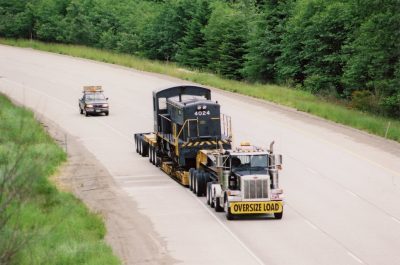
The #4012 rolls down I-90 from Snoqualmie Pass. (Editor’s note: this is #4024) NRM Collection
The Northwest Railway Museum is pleased to announce the acquisition of two locomotives for use on the Snoqualmie Valley Railroad. These new locomotives will pull passenger trains on the Museum’s interpretive railroad and move cars and locomotives around the museum.
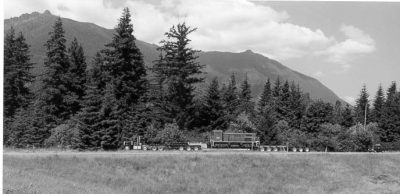
The #4012 exits I-90 with Mt. Si as a backdrop. NRM Collection
The units were built by Baldwin in 1954 and are rated at 400 horsepower. They used to operate at an Army supply depot and were stored in Yakima. They were acquired from the federal government through the Federal Surplus Program and are a donation, although the Museum had to pay a modest processing fee.
Although historic, these locomotives are not being accessioned into the Museum’s Collection. They are operating locomotives and will be used and treated as tools, not museum artifacts. Plans are to operate the new locomotives together in a “multiple unit” configuration.
Why two more locomotives?
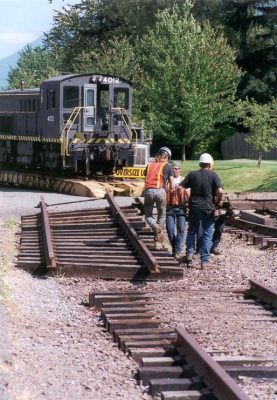
A new section of rail is built to connect the truck bed with the end of the existing track. NRM Collection
Why new locomotives? The Museum has been operating the former Kennecott Copper Alco RSD-4 (#201) for over 6 years. Although the Alco is reliable and has been properly maintained, the Museum must also have a reliable backup locomotive. The Museum’s other locomotive, the ex-Weyerhaeuser Fairbanks-Morse H-12-44, can substitute for the #201 but is in need of a major overhaul. This overhaul is dependent upon the completion of the Museum’s new Conservation and Restoration Center. But this new facility has been hung up in Snoqualmie’s permitting process since February 2000, and there is no indication as to when the Museum will secure building permits.
But why two? Or, why not get a “Geep” or an “F”? The new locomotives are slightly larger than Cecil the Diesel, the Museum’s 45-ton General Electric locomotive rated at 300 horsepower. By comparison, the #201 is over 130 tons and is rated at 1600 hp. It is not possible to move a locomotive the size of the #201 to the Museum without first taking it apart. Acquiring two small locomotives was simply easier to do than acquiring another road locomotive. “Geep” and “F” refers to locomotives built by General Motors that were once very common throughout the Northwest. They are still available, but they are quite costly to purchase and would cost considerably more to move than the Baldwins.
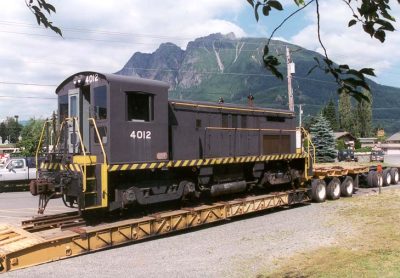
The #4012 arrives at the North Bend Depot by truck. NRM Collection
Any other reasons for getting these locomotives? Baldwin – the same Baldwin that built many of the steam locomotives in the Museum’s Collection — built these units. They are powered by Caterpillar diesels and can be maintained by several local firms. These diesels have antifreeze in their cooling systems and block heaters making these locomotives ideal for operating future winter trains. And the new locomotives have about the same axle loading as the passenger coaches, so they are not as hard on the track.
How did they get here?
The locomotives were moved over a two-day period by the Museum’s rail contractor, Interstate Rail, and United Motor Freight of Seattle. The rail contractor built a small ramp to push each locomotive up onto the bed of a lowboy truck trailer. The deck of the truck had rails already attached.
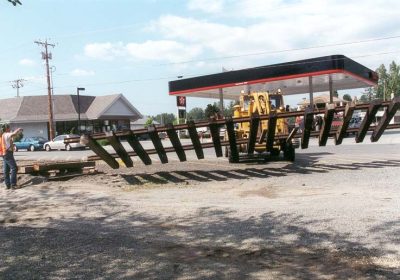
The Pettibone lifts a section of track into place. NRM Collection
Work began in Yakima at 7:30 a.m. Thursday, June 28. The first unit to move was the #4024, and it was easily rolled up onto the truck. The ramp construction and loading process took approximately 4 hours, and the truck was set to leave by noon. It rushed off to the local truck scale, where they verified that the total weight on the road topped 230,000 pounds. It sat there approximately 2 hours waiting for an oversize load permit. And the truck was oversized even without a 60-ton locomotive on its deck: it has 13 axles and stretches nearly 140 feet from cab to tail lights! Shortly after 2 p.m., the truck pulled onto the Interstate bound for the Northwest Railway Museum. The truck was restricted to 50 miles per hour and reached North Bend at 5:30 p.m.
Unloading was performed in front of the North Bend Depot. The truck parked at the end of track just east of the Depot, and Interstate Rail built 60 feet of track to connect the rails on the truck with the Snoqualmie Valley Railroad. The Museum’s Pettibone Speedswing, engineered by Rich W., coupled up to the #4024 and pulled it off, dragging the locomotive’s brakes so that it wouldn’t “get away” (the locomotive weighs over 5 times as much as the Pettibone). Once positioned in front of the North Bend Depot, locomotive 201, crewed by Brandon C. and Dale C., took over and pulled the #4024 to Snoqualmie.
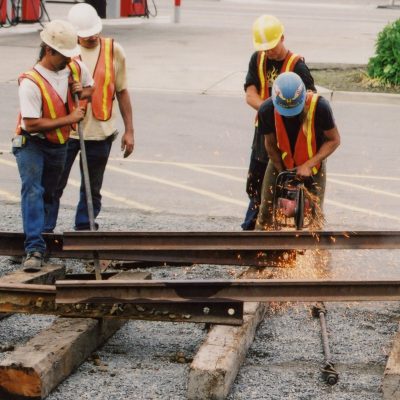
Rail connecting the truck bed with existing track is cut to fit. NRM Collection
Day two was Friday, June 29, and work began at 8 a.m. Although we’d hoped loading of the second locomotive would go more quickly, we had not counted on part of the locomotive pilot interfering with the ramp. A short delay ensued while Interstate Rail workers cut off the offending part and safely stowed it on their truck. But locomotive 4012 still managed to get to North Bend before 4 p.m. Unloading of the #4012 went just as smoothly as the first one, and again it was pulled off with Rich W. operating the Pettibone. The #201 pulled the #4012 to Snoqualmie with a crew consisting of Brandon C., Les K., Bob L. and David O.
Are they operable?
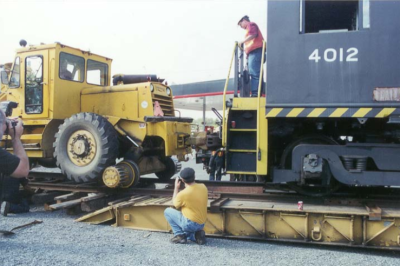
Steve P. and Curator Richard A. monitor the coupling as Rich W. backs the Pettibone onto the #4012. NRM Collection
The locomotives were sold to the Museum in operating condition, but unfortunately the souvenir hunters visited first. Several air brake components, bells, whistles, a step light and even the whistle valve were pilfered. So before the locomotives can be operated in a train, the Museum has to acquire a few parts and install them. And new pilots have to be made and installed. The originals were removed before the locomotives moved to Yakima several years ago. But the locomotives are functionally complete, and the Federal Surplus Agent researched the records and said they were both in service until shipped to Yakima.
When the locomotives are operational, the Museum will be placing its name on the side. Although the locomotives carried the name “US Army” for nearly 50 years, the Northwest Railway Museum is not a military museum. Painting the locomotives as Army artifacts doesn’t accurately reflect what the Museum is interpreting: the role of the railroads in developing the area of Washington State. And painting them for a Northwest-area railroad would be misleading the public, since none ever operated in the area.
Come to the debut July 21
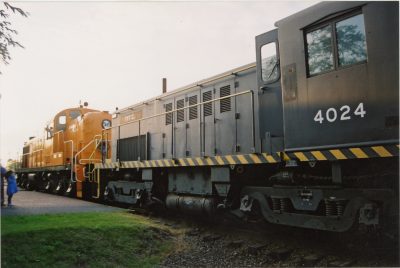
The #201 gets ready to pull the #4024 to Snoqualmie. NRM Collection
The first locomotive to arrive, the #4024, was started and operated July 3, and the Museum plans to introduce this unit to members and volunteers at the annual summer barbeque at the Snoqualmie Depot Saturday, July 21.
